The evident progressive values of this coffeeshop stopped when a possible union was in the offing, as the statement below by the workers pro-unionization movement asserts.
Visitors to Heine Brothers Coffee shops are greeted by large photo displays assuring them the multi-national fair trade coffees sold in this Louisville-area chain are helping the world's poorest improve their lives.
When they make their purchases, signs by the counter tell customers each employee's name - and their pronouns.
Heine Brothers shops have satisfied the political leanings as well as taste buds of left-of-center Boomers, X-ers and Millennials since opening in 1994 in Louisville's eclectic Highlands district. And any nearby BLM rally, jazz festival, or Reiki practitioner is sure to be promoted by fliers inside one or more of the 17 Heine Brothers shops in greater Louisville.
Heine Brothers owners are glad to open their shops as gathering places, discussion spots,
and organizing hubs for advocates in
struggles for justice everywhere --
except at Heine Brothers, apparently.
On June 30, the Heine shop in a historic neighborhood called Douglass Loop was closed permanently by order of company owner and co-founder Mike Mays -- in the middle of the afternoon with not even one minute of advanced notice.
Mays then instructed workers to ask all customers in the store to leave immediately.
Heine Brothers workers involved in a unionization group called HB Workers Union said the stunningly swift closure at Douglass Loop wasn't by chance. They said that shop's employees were among the prime movers in that union drive, which was being made in conjunction with the Service Employees International Union.
Mays told public radio station WFPL the company's reasons for closing that store were not anti-union. He said that while every other Heine Brothers location outside of downtown had drive-through service, the design of the Douglass Loop store -- a tight triangle based on an early 1900s street car turnaround -- precluded drive-through.
An online statement by HB Workers Union members, however, called that explanation for the sudden closing, "outrageous and highly suspicious, considering this location has some of the most outspoken and visible union supporters who have been leading our organizing campaign.”
Douglass Loop Heine worker Gami Ray told online news source Spectrum News 1, "Our store was the first store to show up completely to the [union organizing] meetings; as well as the first store to complete our petition signings. We’ve been the most vocal about it online.”
Pro-union activists also have cited this statement in April 2022 by a Heine Brothers spokesperson on Louisville television station WHAS as indicating that stopping a union was a concern of the business, and consequently a prime motive for the Douglass Loop closure:
“While we respect our employees’ right to organize, we believe that, as a locally owned and operated company, Heine Brothers is well positioned to address the ideas and concerns of our employees without the involvement of a union."
Strategic battles at Heine Brothers' Douglass Loop coffeehouse once were a game, but now are a human rights struggle.
The Douglass Loop Heine Brothers conflict typifies the duality of businesses leaning left on social egalitarianism while sharply opposing economic egalitarianism.
The train of locally owned progressiveism classically slams to a stop when going left means threatening corporate assets, instead of just taking ethical stances which also help create new markets. Those can include the LGBT+, immigrant and refugee, and neuro-diverse people who made up much the the Douglass Loop store's customers, and its workers.
In the historically pro-union city of Louisville, the national trend of coffeehouse baristas unionizing is alive: a Starbucks in Louisville's eastern suburbia has unionized. Moreover, the recently formed Old Louisville Coffee Co-op in that historic central city neighborhood is worker owned.
The Douglass Loop former Heine Brothers location will soon get a new tenant; a craft brewery will move in, and will sell Heine Brothers coffee.
Workers at Heine Brothers throughout the Louisville area will continue their unionization drive, which began in early 2022 after workers got no action from their request that the owners reinstate a customer mask mandate they felt was needed to protect their heath from Covid.
Inside and out, a conspicuous inactivity at Douglass Loop. Is that meant as a chilling message to union activist baristas?
Organizers said increasing wages to livable levels from the basic $9.25 Heine Brothers pays is a central purpose of the effort to unionize. They also said the immediacy of the Douglass Loop closing underscored the need for a union, as being unionized would have required advance notification which would give workers time to negotiate better closing terms and look for new jobs.
A statement posted by the Heine Brothers owners inside the window of the closed Douglass Loop store, however, said that store's manager and employees had all been offered positions at other Heine Brothers locations. (Mays told media that offer also includes stipends to help with the transition, or severance benefits.)
On the window's outside a printout of an HB Workers Union twitter statement was recently posted. While noting that the Heine Brothers company projects a progressive image via Fair Trade coffee and the embracing of gender fluidity, the statement asked: "What's progressive about abandoning the workers who have run your store for years? What's progressive about abandoning the workers who learned the names of your regular customers?... We, the Heine Brothers organizing committee will not be intimidated or silenced by threats of store closures or other anti-union activity. Organizing is a right."
The most important election of our time is coming -- again.
At stake is -- everything, just like in 2020, and the midterms of 2018, and so on back in the timeline of our 365-day-a-year election cycles.
The iPad has become an anxiety device.
And there is a lot at stake in the results of Nov. 8's general elections. They will determine whether the Democrats hold or lose their de facto majority in the U.S. Senate, or even gain a seat to go up 51-49. And that means the difference between Federal Court and any Supreme Court openings in the next two years being filled by Biden nominees, or blocked by boss Koch and his sock-puppet Senate Republican leader.
The outcome of these midterms also will show whether Republican jitteriness over the end of Roe v. Wade proves justified or just a bump in the road on their strategy of igniting their far right base by taking extremist positions.
So, yes, we should all be involved and stay informed -- even if that means lying awake a few nights until November.
But do I, a resident of Louisville, Ky., need to be made to feel personally responsible for who wins in Wisconsin, a state I've only been to one time?
"BREAKING POLL -- Barnes is up on Johnson in Wisc!" an email headline imposed on me as I was quietly scrolling the other night. I didn't know who either Barnes or Johnson were, but five minutes later, I certainly did.
Democrat Lt. Gov. Mandela Barnes had expanded his lead to 7 points on Republican U.S. Senate incumbent Ron Johnson, according to a Marquette University Law School poll.
Other equally impassioned emails tell me Georgia Senator Raphael Warnock is statistically tied with Republican Herschel Walker, the former football star who has written that he has Dissociative Identity Disorder. Walker was described in a 2001 police report as "volatile" and having "violent tendencies," and he has fathered three out-of-wedlock children, along with one with his then-wife, who told police Walker once held a gun to her head and threatened to pull the trigger. The candidate has not denied that allegation.
Unqualified, unstable and dishonest -- the perfect GOP credentials of Herschel Walker
Walker is being treated for his mental illness by a theologically but not medically trained counselor who believes in demonic possession and touts methods debunked as pseudo-therapy.
The patient insists his DID is under control, but he has recently falsely claimed he had been a member of Georgia law enforcement, and said he graduated from the college he actually left after his junior year.
It gets worse: Walker, a critic of black men who are absentee fathers, also at first said he had just one out of wedlock child, but later was found to have three. When asked about this, he insisted he somehow had not failed to disclose their existence.
And this person is tied with Senator Raphael Warnock, a recognized scholar, theologian, and family man who has stood in the shoes of Martin Luther King Jr. by serving as pastor of Ebenezer Baptist Church.
MSNBC explains exactly who has McConnell fretting over "candidate quality."
Back to the nightly e-mails, Georgia democratic gubernatorial candidate Stacey Abrams, who is one of my favorite Americans today, isn't behind right wing incumbent Brian Kemp. No, no, let us say she is within the polling margin of striking distance and solidifying her hold on key voter groups, which is something like the kind of chin-up e-mail headlines I see on her race.
I love what Abrams is doing for voter access and fervently hope she wins, but when I see all these emails at once, it's like the internet is holding me personally responsible for Georgia's outcome as well as Wisconsin's -- oh, and Pennsylvania's, where populist liberal John Fetterman has an 8-point lead over TV doctor/huckster Mehmet Oz in a race to replace retiring Republican Pat Toomey. Still, lots of negativity by pro-Oz groups are ripping at Fetterman on many fronts, so I'll have to check nightly to see how that lead holds up.
As the U.S. leans Blue, the GOP leader feels blue.
I want to be kept up on these races, but I'd rather not be kept up by them as I learn via nightly scrolling that the future of the U.S. will be either progressive or fascist, depending on the whim of people I will never know in states 500 miles away.
So I'm going to give another round of support to my candidates (note: as a federal employee, I need to make clear I am not urging anyone to give money) and shift those nightly grabber alarmist e-mails into the - as misnamed as this term is - junk bin.
I still love the progressives Raphael, Stacey, and John, but I'll enjoy a proper amount of sleep not having to drop off to fears that our democracy depends on precisely how many voters in places three states away from my home fall for a football star who can't seem to keep it straight how many children he has.
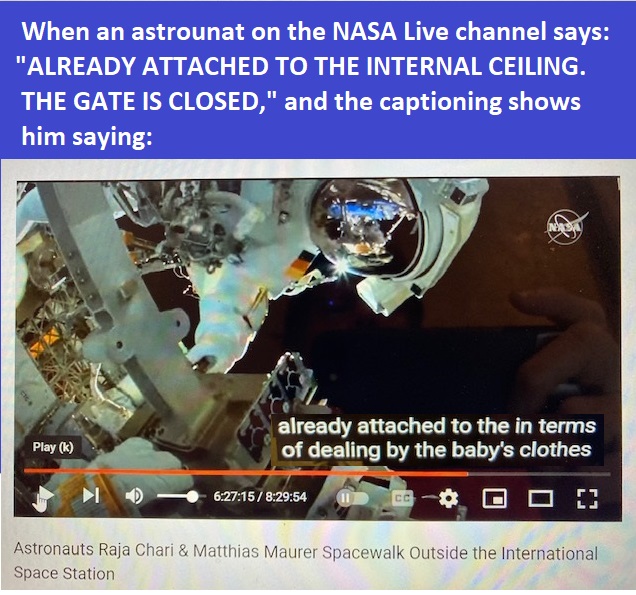
The International Space Station has been good for humankind, as has space exploration overall. They've returned benefits far greater than the costs. But NASA and the other nations supporting the ISS might not be getting their money's worth on the closed captioning of online live space walk coverage. So, while watching this EVA on March 23, 2022, Houston, we've had a chuckle.
OOOPS, trouble with the law...
Well, that was one wild ride!
Longtime space exploration supporter Brian Arbenz, who lives in Louisville USA, invites you to link to the NASA Live coverage of this March 23 space walk:
When you're a Hoosier, you forget all your cares by walking into a gym for a basketball game.
In high schools of all sizes, from Indiana's inner cities to its rural hamlets, the talents of players and the passion of fans of the game called "Hoosier Hysteria" erase from the mind such matters as the inclement weather, Monday's math test, past due bills, crime, and politics. And, certainly, life's tragedies - that's the last thing you think of at a basketball game.
JOY BEFORE TEARS: Terre Haute South fans hoist Mike Joyner after a 1977 tourney win. By year's end, he was dead in an aviation disaster.
The finesse, fundamental soundness and enthusiasm of those young players seemed to spell long lives ahead, particularly when you're watching the Indiana state championship Final 4, the command performance of high school play nationwide.
And yet -- when I have done online searches to find what became of some of those revered athletes I recall watching on television or in person at the Final 4 and elsewhere during the '70s and hence, I have often been stunned and saddened to find that their fates were that last thing you think of when watching the game that means life, youth and fun.
In events mostly involving vehicles, or sometimes illnesses, so many of my favorite Hoosier hardcourt luminaries had their lives cut short, often dying while still in their 20s. Their deaths were generally from unforeseeable accidents -- being in the wrong car or airplane at the wrong time. Check a YouTube on an Indiana basketball player from my high school and college years in the '70s and you just may see RIP in the comments, along with tear emoticons.
Here is the list of known deaths of standout players from the 1970s and early '80s who starred at Indiana's Final 4 or otherwise attained Hoosier high school basketball prominence:
Stacey Toran, a likeable, quiet Los Angeles Raiders defensive back who in 1980 had hit the 57-foot shot shown above in leading Indianapolis Broad Ripple High School to the state title game, died at 27 on August 5, 1989 when his car flipped over near his home in Marina Del Rey, Calif. He he was returning from a team open house at a high school in Oxnard which followed a pre-season practice with the NFL team.
Toran was engaged to be married when he died and described by Raiders teammates as pleasant and positive during the practice and open house. Still, he was well over the legal alcohol limit when his car crashed, but police said there were no skid marks or other indications of speeding.
A court level view of the great shot, which Stacey then describes.
His former high school formed a Stacey Toran Foundation to raise money for college scholarships for financially challenged Indianapolis public school students. The foundation also runs youth mentoring and leadership training programs.
Jack Moore, a 5-foot-8 guard whose outsized skills surprised opponents at the 1978 Final 4 as he led Muncie Central to a state championship, died in a private plane crash on March 3, 1984, two years after graduating from the University of Nebraska.
Moore and a business partner, stockbroker Gary Johnson of North Platte, Neb. were flying back from Indiana, where they had watched Moore's former high school team play. Johnson was piloting the plane, which ran into unexpected storms and fog over central Nebraska, then crashed on a ranch.
Twenty-five years after their deaths, the Lincoln, Neb. campus saluted the popular player and straight-A student with Jack Moore Day coinciding with a Cornhusker basketball home game. Halftime featured appearances by Jack Moore's mother and his sisters, one of whom, Jane Ann Giles, still kept a small piece of the plane in which her brother had died as a memento; she said it gave her consolation.
During his playing days, Moore's athletic frame was ideal for sports in general, but appeared simply too short for Division 1 college basketball; still, using the same finesse and daring that wowed Final 4 fans in Indiana, he stood out nationally at Nebraska, winning the 1982 Pomeroy-Naismith Award for the nation's best senior player under six feet tall.
A bit of Jack Moore's "absolutely unbelievable" 1978 state title game play.
Moore had been revered at Nebraska and in Muncie as a smooth, agile court tactician and easygoing public role model. He quickly fell in love with his adopted home state, encouraging high school teammate Jerry Shoecraft, his best friend since childhood, to enroll at Nebraska and also play for the Cornhuskers.
Shoecraft, who went on to serve on the City Council of Lincoln, said on a University of Nebraska site: "I probably would have gone to Purdue if Jack hadn't convinced me to visit Nebraska.... Everything I've ever accomplished in my life was because of him and the way he inspired me. Even now, whenever I'm down, tired, angry or staring adversity in the face, I ask myself the same question: 'What would Jack do?' "
Kevin Thompson at Terre Haute South
Kevin Thompson was considered the hope for an upswing at Indiana State University when the star forward signed with hometown ISU in 1980, a year after the incomparable Larry Bird graduated. Sportswriter Seth Davis described Thompson as, "a big, strapping six-foot-eight forward whose square chin, finely combed black hair and glasses made him look like Clark Kent. He was also a local celebrity, having earned all-state honors at Terre Haute South Vigo High School."
Man of Steel though he made have evoked, Thompson took an injury to a rib during the summer of '80, and when it had not healed by the start of Thompson's freshman fall semester, a deeper problem was indicated.
A doctor diagnosed him with cancer, turning Thompson's planned battle for a starting spot with the Sycamores into a battle for his life. He died in January 1982, never having played a game at Indiana State, and leaving a wife, Tammy.
"He was a courageous young man who fought a good fight," Indiana State coach Bill Hodges said.
The day after Kevin Thompson died, Hodges resigned the coach position. He had gone through a difficult post-Larry Bird losing season in 1979-80, a divorce, then the death of a promising forward, but more so a young person Hodges had befriended during recruitment efforts from just across town.
"I grew to know him so well, and it tore me apart," Hodges said.
Tony Winburn of Jeffersonville High School was -- like Jack Moore -- 5-8 and won fans with an energetic, overachieving style of play. Also like the Muncie star, Winburn died in a plane crash in his 20s. Marion Anthony "Tony" Winburn was one of 29 people, including the entire University of Evansville basketball team, killed Dec. 13, 1977 when their propeller charter plane crashed just after takeoff on a planned trip to Tennessee for a game. The crash also killed head coach Bobby Watson and acclaimed Evansville sportscaster Marv Bates.
Winburn was a star on the 1972 Jeffersonville Final 4 team, which lost in double overtime to that night's state title winner. In 1973 his Jeff squad had been ranked No. 1 during the season, but was stunned in the state tourney's first round by arch rival New Albany, a team which had struggled mid-season but went on to win one of the most surprising state championships ever. They stole the title glory Jeffersonville fans believed would be theirs.
A New Albany substitute who helped turn that team's fortunes around was Steve Miller, a 6-8 sophomore forward who helped point his squad to the 1973 Final Four, but did not play there. Expense restrictions limited state tourney rosters. Miller was a starter his last two seasons at New Albany, and joined former rival Tony Winburn as a 6-9 forward on the ill-fated Evansville Purple Aces team. Miller was married four months before he died.
Terre Haute South Vigo High School's Mike Joyner, who was a senior on South's 1977 Final Four team, died in the crash that December after playing four games in his freshman season at Evansville. The Purple Aces' last game, three days before their deaths, was at Indiana State University in Mike's hometown, giving him some family time, including seeing his newborn sister Peggy for the second and final time. Mike also gave his mother Martha Joyner his Christmas gift wish list, which included sweaters and an electric blanket, she told the Terre Haute Tribune-Star in 2014.
As though Evansville fans hadn't had enough pain from the Dec. 13, 1977 crash wiping out their beloved Purple Aces team, a coincidental accident two weeks later killed the sole team member who had avoided doom by what seemed like the divine fortune to have a serious pre-season practice ankle injury that bumped him from the roster, keeping him off the plane.
Freshman David Furr, 18, who during his ankle's healing was working as a statistician at home games, then after the plane crash planned to join a new Evansville squad to be rebuilt the next year from catastrophe, was driving on Dec. 27 with his 16-year-old brother near their hometown in Illinois when their vehicle was hit by another driver, killing the brothers.
As is detailed on the website bird in flight dot com, which includes stories of aviation deaths it says contain a hint of predestination, the car carrying David Furr and his brother Byron Furr was hit by a pick up truck near Newton, Ill. while David was home from the bereaved campus on holiday break. The brothers were returning from a high school basketball game in Olney, Ill.
The Furrs' deaths added one more community to the list of stricken hometowns of Purple Aces players. Thirty years after the plane crash, a story in the News and Tribune in Jeffersonville included remembrances by Tony Winburn's mother Edna Winburn of half-mast flags throughout the city of Jeffersonville and constant expressions of condolences to her.
"A lot of people around here were very hurt and concerned about Tony," Edna Winburn told the newspaper. "And people still bring it up to me now, but not as much as in the past.
"He enjoyed going to school and playing his sports," she said of her son, who would have earned a business degree from the University of Evansville in the spring of 1978. "He was just a very congenial guy, never gave me any trouble. I'll never get over wishing he was still here."
Steve Miller's widow Vicky Peay, who has since remarried, said in that 2007 story: "The people around here could not have been better," adding that their kindness after the tragedy enabled her to become skilled at helping people after painful losses. "You can take something like this and become a bitter person. Or your can use it for good and help others."
Tommy Baker, in the video excerpt below from the 1974 Final 4 at Bloomington, is described as "in trouble" until a Jeffersonville teammate maneuvers in his direction to receive a pass from the then 6-foot-tall freshman. That brief interlude from early in Baker's great career for the Jeff Red Devils ominously foretells the path his life would take.
Unfortunately, when Tommy Baker got "in trouble" later at various life stages, the system wasn't there for him, and the Indiana high school All-Star from 1977 slid down a slope through controversies, incarceration and destitution, dying of pneumonia at 51. In 1978, early in his sophomore college season at storied Indiana University, Baker was one of three players dismissed from the team by the iron-willed coach Bobby Knight reportedly over marijuana possession.
That un-glorious exit ended great hopes for IU stardom that began when -- as a Louisville newspaper sports columnist recalled it -- the high school senior Baker opened the curtains at his family's home in Claysburg, a historically black section of Jeffersonville, and gushed over seeing the legendary coach Knight getting out of his car on a recruiting visit.
There was much else that indicated Tommy Baker was a good match for Knight's program. The three-year starting guard at Jeffersonville was skilled at the motion offense, passing and pressure defense, the three legs of Knight's system which brought about an undefeated NCAA title in 1976. That was the same season that high school junior Tommy Baker led a talented Red Devil team that lost in the afternoon semis of the Final 4 by three points to that night's state champion Marion. In Baker's freshman and senior seasons, Jeffersonville also had state titles within their grasp, but suffered close tournament loses.
After his exile from IU in late 1978, Baker had a successful two years playing at Eastern Kentucky University, but was cut in rookie camp after the NBA's San Antonio Spurs drafted him. A young man who had befriended Magic Johnson in 1977 as the two visited Germany winning the co-MVP honors on a team of U.S. high schoolers now would never take the court in the NBA his one-time peer Magic was dominating.
Back in Jeffersonville, Baker was arrested and imprisoned multiple times for selling cocaine, but critics of our nation's imprisonment-centered justice methods contend that Baker and the millions of other nonviolent offenders who have been sent to violent prisons are the real victims.
Much of Tommy Baker's problem, in one graph.
And Clark County, Ind.'s prosecutors went with the national paradigm of incarceration as the only way to respond to drug possession -- oh well, providing the offenders are not rich. Admitted past cocaine users Robin Williams, Lawrence Taylor, Steven King and presumed hard drug user George W. Bush would simply never have gotten prison, but a kid from Claysburg would. By the 2000s, Tommy Baker was an ex-con, broke and ill; he died in 2010 and was buried in a pauper cemetery in Louisville. Jeff High graduates formed a Facebook group to raise money to locate his unmarked grave and inscribe it with fitting markings noting their fondness for their schoolmate.
One poster on an IU fan site, who as a Jeffersonville High student followed Tommy Baker by a few years, sadly announced Baker's death on the site in 2010, saying, "I didn't know him well, but he was a good kid and a hard worker. Well liked. Very humble young man."
John Hollinden in the high school class of 1976
John Hollinden left his hometown of Evansville a 7-foot-4 Central High School graduate in 1976, but was really tall when he returned two years later. After struggles with growth spurts made it difficult to hit his stride in two seasons at Oral Roberts University, Hollinden came back to join the Indiana State University at Evansville team as a 7-7 center -- the nation's tallest basketball player.
Two productive seasons later, the popular and easygoing Hollinden signed to play professionally in a European league, but the night before his scheduled departure in 1981, another episode of dread familiar to Evansvillians struck. John was driving for pleasure outside the city when his car crashed, leaving him permanently paralyzed from the waist down. The giant niceness for which this giant was known endured; John began working with two charities helping the poor, became a motivational speaker, and joined a choral music group.
Even after leg infections, then amputations of both legs in 1991, Hollinden remained a model of good spirits, his former high school coach John Wessel said.
"I went to see him in the hospital after that operation, and he had more grit and determination than the law allows," Wessel told the Evansville Courier. Nonetheless, John Hollinden died in 1992 of cardiac arrest brought on by infections. He was 34.
Basketball will always be exciting to me, and the Indiana high school kids' way of playing the game -- smart, graceful and polished beyond their years -- creates an aesthetic unattainable anywhere else. Hoosier fans packing gyms to boil over with their unique brand of hysteria can convince us that it really matters who wins the game.
It shouldn't take tragic deaths to remind us of the siblings, parents, hobbies, neighborhoods, faiths and fun that matter most in the lives of youths who wear their school's uniforms only a few hours a week.
In researching these stories of lives which ended too soon, I've realized that we had great folks in ballplayers like Jack, Tony, Tommy, Steve and John. Moreover, I've learned the importance of appreciating talented, energetic and devoted people while they're still here.
Brian Arbenz grew up a classically hysterical Hoosier, and he gained even more appreciation of basketball and its players while working as an independent contractor sportswriter from 1986 to 1999, primarily covering Indiana high school games.
To help retire that well worn list of JFK-Abraham Lincoln “history repeats itself” mystical eerie unexplainable similarities (like a school book warehouse being the same thing as a tobacco barn), I present:
John F. Kennedy-James Garfield assassination similarities!
This list of unexplainable coincidences is dedicated to the reality that by turning over enough rocks and framing selected details just right, we can “prove” anything we wish to.
Here they are:
Kennedy and Garfield’s successors, Lyndon Johnson and Chester Arthur, both had 13 letters in their names.
Johnson got Kennedy’s proposed Civil Rights bill passed by Congress, a first step in long needed progress.
Arthur got Garfield’s proposed Civil Service bill passed by Congress, a first step in long needed progress.
Kennedy’s assassin Lee Harvey Oswald pleaded for a favor (upgrading his dishonorable discharge from the Marines) by writing the Secretary of the Navy, and was angered that he got no response. He then wrote to the FBI threatening violence against high U.S. officials.
Garfield’s assassin Charles Guiteau pleaded for a favor (appointment as consul to France) by writing the White House and was angered that he got no response. He then wrote to the Secretary of the Army threatening to kill the president.
The assassination of Kennedy prompted a technology invented by Alexander Graham Bell to fail when Washington, D.C. phones widely went out from overuse when news of the shooting broke.
The assassination of Garfield prompted a technology invented by Alexander Graham Bell to fail when a metal detector Bell brought to the president’s doctors to locate the bullet could not find it.
Oswald and Guiteau both had mothers of French descent.
Both assassins had battered their wives. Both had trouble holding jobs down.
Oswald and Guiteau had moved to New York City in their youths.
Both also moved to what they thought would be utopian socialist places (Oswald the USSR; Guiteau the Oneida Biblical community in New York State). Both left disillusioned.
Oswald and Guiteau both bought European-made guns valued at less than $20 from U.S. vendors to carry out their assassinations. Both presidents were hit by two bullets. Both were just a few feet from railroad tracks when shot.
Kennedy and Garfield both won, for their respective times, the closest popular vote victories by anyone elected president. Garfield beat Winfield Scott Hancock by 10,000 votes; Kennedy beat Richard Nixon by 100,000 votes.
Presidents Kennedy and Garfield opposed racial discrimination, both appointing record numbers of Blacks to federal positions.
Kennedy and Garfield both had two children die young. Both had two children go on to become lawyers.
Kennedy and Garfield fought in wars 20 years before their deaths, both being hailed as heroes in those wars.
The Camelot president’s grandchildren can read a comic strip about a cat called Garfield.
President Garfield’s grandchildren could read a comic strip called Prince Valiant, about a place called Camelot.
Kennedy’s widow went on to marry a Greek who had accumulated wealth.
Garfield’s widow went on to marry a geek who had accumulated welts -- no, actually James Garfield’s wife died before he even became president. But then Abraham Lincoln never had a secretary named Kennedy, which underscores how a little fibbing is part of this art! But all else on this list is true.
In 2003, as the invasion of Iraq commenced, administrators at three Albuquerque, N.M. high schools suspended or placed on paid administrative leave five teachers who had displayed antiwar posters in their classrooms, some created by students.
Officials claimed they were violating an Albuquerque Public Schools policy that requires educators to maintain a classroom atmosphere free from bias or prejudice.
One teacher resigned after the incident. Two others, employed on yearly contracts, were not hired back by their school.
Okay, all you valiant opponents of Cancel Culture, this is your cue! But where were Fox News, Patrick Buchanan or Dennis Prager when it was time to defend these teachers and condemn the stifling of debate -- and by one of those bias-free policies they are always denouncing!
That same year CBS caved in to a conservative firestorm and decided not to air its own made-for-TV movie “The Reagans,” featuring James Brolin playing the 40th president in what preview watchers described as a non-flattering light.
The network disgraced the legacy of Edward R. Murrow by punting the movie off to the cable channel Showtime.
And today’s fierce critics of Cancel Culture, or their forerunners in 2003? Surely, conservatives condemned CBS’s dropping its movie as mob rule censoring the airwaves. Nope, conservatives were that mob.
Same comfortable silence from the right in 1995 when ABC radio dropped -- let’s say it -- canceled the show “Hightower Radio,” whose feisty Texas host Jim Hightower attacked factory farming and other chemical-based industries as destroying the land and community economics.
ABC's big advertisers decided you won't hear this type of information.
The multi-billion dollar Archer-Daniels-Midland, one of the key creators of those farming methods, bought myriad advertisements on ABC-TV’s “This Week With David Brinkley.”
The network openly said that unnamed advertisers felt Hightower’s criticisms were against their interests.
What, those big city eastern network people are censoring a good ole Texas man of the soil?, screamed absolutely no conservative whatsoever.
And this year, Harvard surprised everyone by passing over acclaimed intellectual Cornell West for tenure.
The college offered West, a longtime attacker of colonialism and supporter of the Palestinian cause, a pay raise absent of tenure. That’s a move so contradictory that outside pressure from pro-Israel absolutists and power elites dependent on colonialist exploitation likely prompted it.
West said that’s what happened, though Harvard denies it.
Well, that concludes our Conservatives’ Hypocrisy by Silence Tour, though there are many more examples, such as, JUST IN:
Yeah, there are also left-driven episodes, but overwhelmingly they aren’t equivalents, because they’re not about intimidating critics of war or factory farming.
Consider the case of Don Imus, whom CBS radio let go for referring to black members of Rutgers’ woman’s basketball team as “nappy-headed hos.”
And longtime CBS sports broadcaster and odds maker Jimmy “The Greek” Snyder was dropped in 1988 after he made rambling, asinine comments about black athletes owing their talents largely to slavery’s breeding practices. Snyder also said blacks breaking into the coaching profession should be seen by white coaches as a threat to their opportunities.
Was there a better way to respond than firing Snyder?
Ed Hotaling, an African-American reporter/producer for a Washington, D.C. TV station who recorded and broadcast the remarks, said CBS should not have fired Snyder. Instead, Hotaling said the incident should have cued the network to explore racism straightforwardly.
“I think you have to think a little more broadly than firing a sports commentator for expressing stupid comments about civil rights,” he said. “You should start covering the story and let him learn something.”
Hotaling suggested letting Snyder discuss his remarks and the wider issue of civil rights with black and white athletes on CBS’ football coverage.
“His views would be expressed a little more adequately, I think,” Hotaling said. “They’d have the thing resolved in a positive way instead of a negative way.”
Today's retributive discourse, the wider problem than just Cancel Culture.
Hotaling has the right idea overall. Though as someone who remembers Snyder’s insipid pseudo-history lessons in that 1988 broadcast, I have my doubts that a person so evidently entitled and isolated as Snyder would be open to learning.
And there is also the matter of Jimmy The Greek’s words revealing an incompetence to be a national sports commentator and forecaster (would we want a TV weather forecaster using crickets and supplicating the god Thor?)
Still, what Hotaling suggested in ‘88 is very relevant to today’s controversies. A speaker or tweeter who makes a short comment should be given more time to explain it, but more importantly should be compelled to, in Snyder’s case, talk repeatedly with great black athletes. He could hear them describe the ways in which their success came not from some ghoulish echo from slave breeding, but from their own hard work and sacrifice.
Responding to bigotry should involve face-to-face discussions and persistent attempts to show the offender what they are missing, not instantaneous sanitizing of discourse that may make us feel better, but leaves the hate unaddressed.
.jpg)
.jpg)
.jpg)


.jpeg)
.jpeg)